
Affiliation No: 2130691
CIE Centre Number - IN139
School Code : 60310
Affiliation No: 2130691
CIE Centre Number - IN139
School Code : 60310
“Which board is better?” is probably the most common question parents ask when choosing a school for their wards. They often feel torn because both national and international board options are widely available and both have strong reputations.
However, we at Indirapuram Public School (IPS), Ghaziabad, firmly believe that the honest answer is that neither board is better in every situation. They are different, and the right one depends on the child. In fact, the decision becomes far easier when parents know how the two differ in everyday learning.
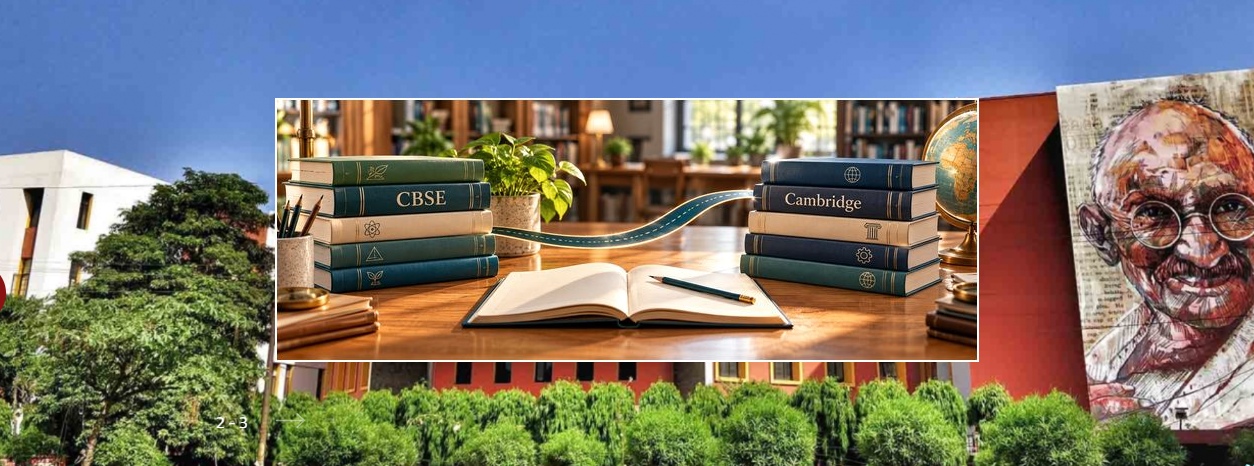
So, if you are a parent comparing the best CBSE schools in Indirapuram with the ones with Cambridge IGCSE curriculum, this blog post explains the main differences between the two in simple terms. It will help you figure out which curriculum is better suited for your child.
The Central Board of Secondary Education (CBSE) is India’s national board, and its curriculum is built around the National Curriculum Framework. The IGCSE, or International General Certificate of Secondary Education, is offered by Cambridge International Education and is taken by students around the world.
In both cases, children study a broad set of subjects before specialising in Classes XI and XII. The difference lies in how they are taught and assessed.
Both curricula aim to build conceptual understanding and critical thinking; they simply get there in different ways. CBSE follows a defined national syllabus built around NCERT textbooks and, in line with the National Education Policy 2020, increasingly uses experiential learning and competency-based questions. IGCSE offers flexible syllabuses that schools teach through a range of resources, often using discussion, investigation and the application of knowledge to unfamiliar problems.
In CBSE, students appear for the Class X and XII board examinations. In IGCSE, students take external papers set by Cambridge at the end of Grade 10, and some subjects include practical tests or coursework. Each pattern rewards a different kind of preparation.
Many national entrance exams, such as JEE, NEET, and CUET, are closely linked to the Indian syllabus, so CBSE students often find the content familiar. IGCSE students can also prepare for these exams, but may need additional alignment with the Indian syllabus. On the other hand, the IGCSE is recognised by universities around the world and leads to Cambridge AS and A Levels.
IGCSE places a strong emphasis on English, and the subject list is broad, with around 70 options globally. CBSE gives strong support to Indian languages, along with a defined set of subjects for each stage.
CBSE schools are found across the country, which can be reassuring for families who may move between cities. Cambridge programmes may carry additional examination fees payable to Cambridge, so ask your child’s school for a complete fee structure before comparing the two.
A CBSE pathway may suit a child who plans to appear for national entrance tests, values strong support in Indian languages, or is likely to move between schools across India. An IGCSE pathway may suit a child who would like a wider choice of subjects, is comfortable learning and being assessed in English, or is interested in studying abroad. Children who enjoy questioning and applying ideas can thrive in either.
Hence, instead of asking which board is better, ask what your child needs. Think about their learning style, the support available at home, and where you hope they will study after school.
Indirapuram Public School, Ghaziabad, is affiliated to CBSE and is also a Cambridge International school. This lets families explore both options within the same school.
On the Cambridge side, the pathway runs from the Reception years to the Advanced programmes (Grades 11 and 12), with about 15 IGCSE subjects offered. On the CBSE side, the school provides smart classrooms, separate physics, chemistry and biology labs, and experimental science from Class III.
Parents who are looking for a CBSE school or a Cambridge school in Indirapuram can also learn how the two pathways differ in day-to-day classroom activity, since both operate from the same campus.
Teachers, counsellors, and the admissions team are available to help families think the decision through.
Yes, though the school will assess the child’s readiness. After IGCSE, students may also pursue CBSE qualifications.
CBSE’s syllabus is closely aligned with national entrance exams, though students from other boards can also succeed with proper preparation.
No. Many IGCSE students go on to study in India. The right choice depends on your child’s subject interests, learning preferences, and future plans.
Neither. The workload depends on the school, the subjects chosen, and the child.
Visiting classrooms and speaking to teachers from both pathways is the best way to compare them. A trial is not possible, but informed conversations are.
Both CBSE and IGCSE can give children a strong education. The right choice is the one that matches your child’s learning style, your family’s plans, and the support a school can provide.
At Indirapuram Public School, a school many parents shortlist when looking for the best CBSE school in Indirapuram, the aim is to give children a strong foundation irrespective of the curriculum they choose to follow. Every classroom has smart-board facilities, science is taught through hands-on experiments from Class III, and computer classes run from Class I to X.
Beyond academics, children explore sports, performing arts, clubs, and MUN, while the Career Counselling Cell helps older students think about their next steps. After all, the curriculum matters, but so does the environment around it.
If you would like to explore the CBSE pathway at our school, or compare it with Cambridge, call us on 0120-2607103 or +91 9560994651 / +91 9599380343, or write to admissions@ipsindirapuramncr.com. We would be glad to guide you through the process.
Useful Links
Reach Us

6, Nyaya Khand-I,
Indirapuram,
Ghaziabad (NCR), India


